ADA Title II digital accessibility deadline // US public bodies
Jan 05 2026
ADA Title II digital accessibility deadline takes effect for US public bodies On April 24th, 2026, updated ADA Title II rules became enforceable, creating mandatory digital accessibility obligations for US public bodies.
State and local government bodies serving populations of 50,000 or more are now required to meet updated accessibility standards under Title II of the Americans with Disabilities Act (ADA).
The rule, finalised by the US Department of Justice on April 24th, 2024, formally extends Title II obligations to websites, mobile applications, digital documents, and online services. From April 24th, 2026, compliance is no longer advisory. It is enforceable.
What has changed
Title II already required public entities to ensure equal access to services. The updated rule clarifies that digital services are explicitly in scope and establishes a defined technical benchmark. Public entities must now ensure that digital content conforms to WCAG 2.1 Level AA, covering usability for people using assistive technologies across sight, hearing, motor, and cognitive needs.
This applies to:
Public websites and mobile applications PDFs and downloadable documents Embedded video and audio Third-party platforms and tools used to deliver public services Smaller jurisdictions serving fewer than 50,000 people have until April 26th, 2027 to comply. For larger entities, the obligation is now active.
Why this matters now
Accessibility enforcement has moved from principle to practice. Regulators and courts no longer accept uncertainty or informal progress as a defence.
Public bodies are expected to demonstrate: Awareness of statutory obligations Evidence of independent assessment A structured plan showing what has been achieved, what is underway, and what may reasonably be classed as disproportionate burden Failure to do so increases exposure to complaints, investigations, and litigation.
Our answer: a practical compliance pathway
The response does not start with remediation. It starts with clarity, evidence, and control.
Step 1 Ensure you have an independent audit. Do this first. This must not be conducted by your web services supplier or incumbent vendor. You can do this free now at www.AAAnow.ai/confirm. The objective is to understand which compliance fundamentals have been addressed and which remain unresolved. Without this step, every subsequent action is based on assumption rather than evidence.
Step 2 Share an internal compliance note Ensure all staff are aware that ADA Title II applies to digital services. This includes communications, IT, procurement, and leadership. Consistency across teams is essential. Fragmentation increases exposure.
Step 3 Conduct a formal risk assessment This assessment must be independent of delivery teams and suppliers. It should identify: Areas of confirmed compliance Known gaps Areas creating unnecessary risk Dependencies on third-party systems and vendors This forms the evidence base for governance and prioritisation.
Step 4 File an ADA SOP (Standard Operating Procedure) Document your position clearly and formally: What has been achieved What is actively being worked towards What may reasonably be classed as disproportionate burden This documentation is critical in demonstrating intent, proportionality, and ongoing oversight.
Step 5 Apply secure tagging and automated controls Use AI and automation to remove a material percentage of exposure and accessibility barriers across live content. This reduces immediate risk while longer-term remediation is planned and delivered.
Step 6 Issue formal notices to suppliers Under various US laws, vendors and service providers have their own compliance obligations. Suppliers should be: Put on formal notice Made aware of their responsibilities Advised of potential liabilities Failure to do this shifts risk back onto the public body.
Step 7 Review insurance and litigation coverage Engage your broker to confirm: Coverage related to accessibility litigation Claims handling capability Availability of litigation support platforms This is a risk management step, not an admission of non-compliance.
A shift from intention to evidence
From April 24th, 2026, ADA Title II compliance is no longer about intent. Public entities are expected to show that they understand their position, are acting proportionately, and are managing digital risk with evidence. Independent assessment is the foundation. Everything else builds from it.
Sources and further reading
US Department of Justice. Final Rule on Accessibility of Web Content and Mobile Apps Provided by State and Local Governments
https://www.ada.gov/resources/2024-03-08-web-rule/
US Department of Justice. Web Rule First Steps
https://www.ada.gov/resources/web-rule-first-steps/
3Play Media. ADA Title II Website Accessibility Requirements
https://www.3playmedia.com/blog/ada-title-ii-for-public-entities/
University of California Berkeley. ADA Title II Updates Explained
https://dap.berkeley.edu/ada-title-ii-updates/title-ii-ada-what-does-it-mean-us
Subscribe to AAAtraq and enjoy complete cover and peace of mind
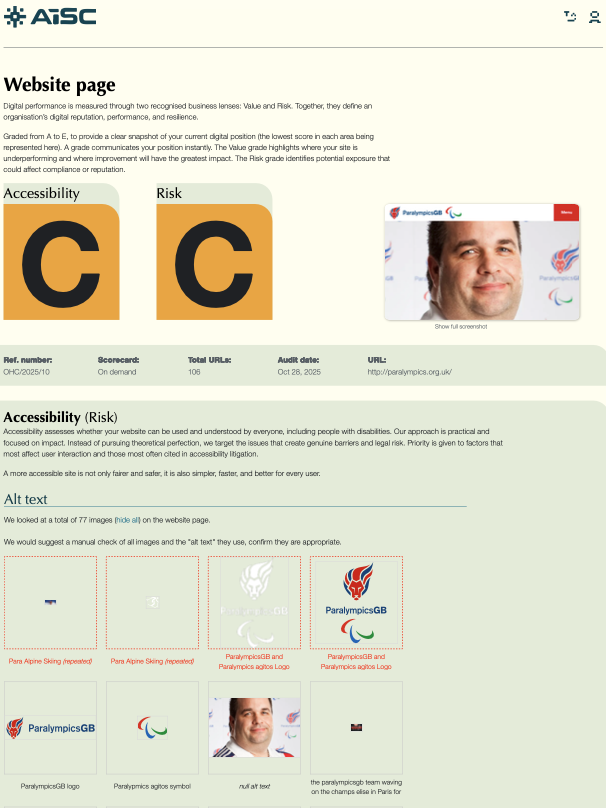
Example - Risk status, and outline of fundamentals needing attention.
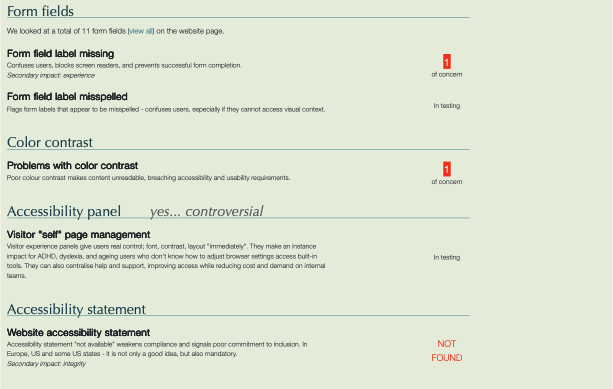
Further details, what is fundamental for compliance - Try any page at www.AAAnow.ai/confirm.